Chronus Health
Whole-blood electrical detection platform — CBC, CMP, and electrolytes from a single cartridge. No sample prep. No optical detection.
Whole-Blood Electrical Detection
The Challenge
Build a CLIA-waived point-of-care device for CBC and CMP testing from undiluted whole blood — no sample prep, no optical detection, and a manufacturing path to sub-dollar cartridge COGS.
Our Role
Co-founders and technical leads across chemistry, sensor design, electronics, and system integration — from feasibility through IRB-approved clinical studies and FDA pre-submission.
How It Works
- 100% electrical detection — no optical components, no sample prep
- Multiplexed: CBC, CMP, electrolytes, and small molecules from a single cartridge
- Proprietary aptamer sequences across 13 analyte targets
- Custom 4-channel lock-in amplifier built in-house at <$2k (vs. $40k+ commercial)
- Ionophore-doped membranes for direct potentiometric electrolyte read from whole blood
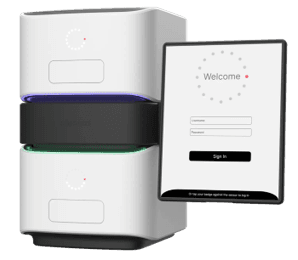
Chronus Health whole-blood POC reader
Complete Blood Count (CBC)
Whole-cell impedance spectroscopy measures red blood cells, white blood cells, and platelets directly from undiluted whole blood. No lysing agents. No dilution. No optical path.
The sensor is a microfabricated, microfluidic device built on a glass wafer — featuring 4 parallel measurement paths for simultaneous multi-analyte detection. The glass substrate enables precise electrode geometries and low non-specific binding critical for whole-blood performance.
The single-use cartridge integrates buffer, mixing chambers, and waste reservoirs alongside the sensor on a single platform — no external reagents, no benchtop preparation. The only step required from the end user is a simple whole-blood dilution before loading.
Validated against a commercial hematology analyzer across 25 volunteers in an IRB-approved study.
25 volunteers · IRB-approved · vs. commercial hematology analyzer
CBC — Correlation (r)
| Analyte | r |
|---|---|
| Red blood cells | 0.96 |
| Platelets | 0.92 |
| Total white blood cells | 0.92 |
| Neutrophils | 0.93 |
| Lymphocytes | 0.89 |
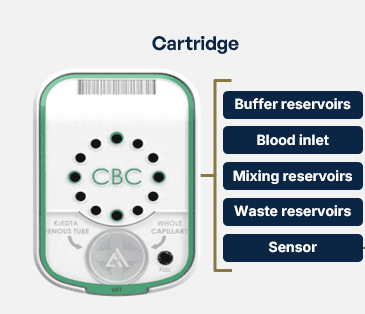
Single-use CBC cartridge — blood inlet, buffer & mixing reservoirs, sensor array
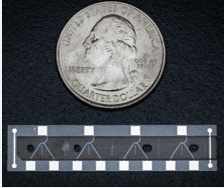
CBC electrochemical sensor strip — shown to scale
Comprehensive Metabolic Panel (CMP)
Liver enzymes and proteins are detected using aptamer-based amperometric electrochemical measurement. Each analyte has a proprietary aptamer sequence selected, screened, and validated in-house — no antibodies, no labels, no reagents consumed per test.
The platform uses proprietary aptamer sequences across 13 analyte targets, representing a core IP asset of the Chronus Health platform.
Detection method
Aptamer-based amperometric detection — label-free, reagentless binding measurement directly from whole blood with no sample preparation required.
25 volunteers · IRB-approved · vs. commercial chemistry analyzer
CMP — Correlation (r)
| Analyte | r |
|---|---|
| ALT | 0.91 |
| AST | 0.96 |
| ALP | 0.96 |
| Albumin | 0.96 |
| Total protein | 0.92 |
Electrolytes & Small Molecules
Electrolytes and small molecules are measured potentiometrically using ionophore-doped polymer membranes — the same principle as ISE-based lab analyzers, miniaturized into a single-use disposable cartridge.
No enzymatic reagents. No reference electrode consumables. Direct read from undiluted capillary or venous whole blood in clinical ranges.
Detection method
Potentiometric ion-selective electrodes (ISE) with ionophore-doped PVC membranes — direct ion activity measurement in whole blood. r² > 0.99 across sodium, potassium, and creatinine.
25 volunteers · IRB-approved · vs. commercial chemistry analyzer
Electrolytes — Correlation (r²)
| Analyte | r² |
|---|---|
| Sodium | 0.994 |
| Potassium | 0.993 |
| Glucose | 0.950 |
| Creatinine | 0.991 |
| BUN | 0.990 |
| Total CO₂ | 0.950 |
Key Engineering Achievements
Custom 4-channel lock-in amplifier
vs. $40k+ commercial equivalent
Analyte targets
Proprietary aptamer sequences
Cartridge COGS target
At 25M units/yr via design + automation
Waiver candidate
FDA pre-submission filed
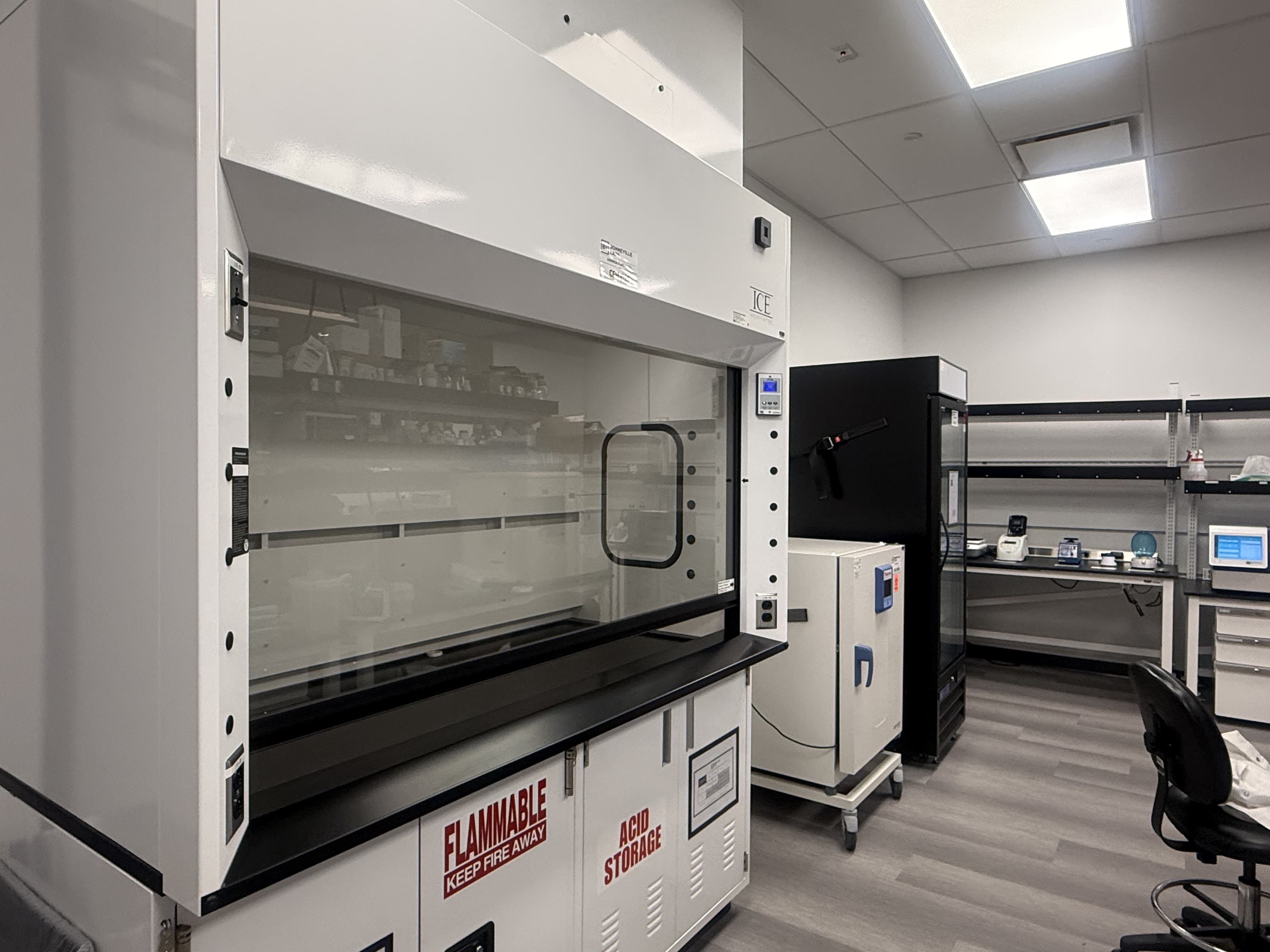
Twenty Seven Labs R&D facility, Hayward CA — BSL-2 equipped chemistry lab
Outcomes
Building Something in Diagnostics?
Let's talk through your project. Initial calls are 30 minutes and completely free.